
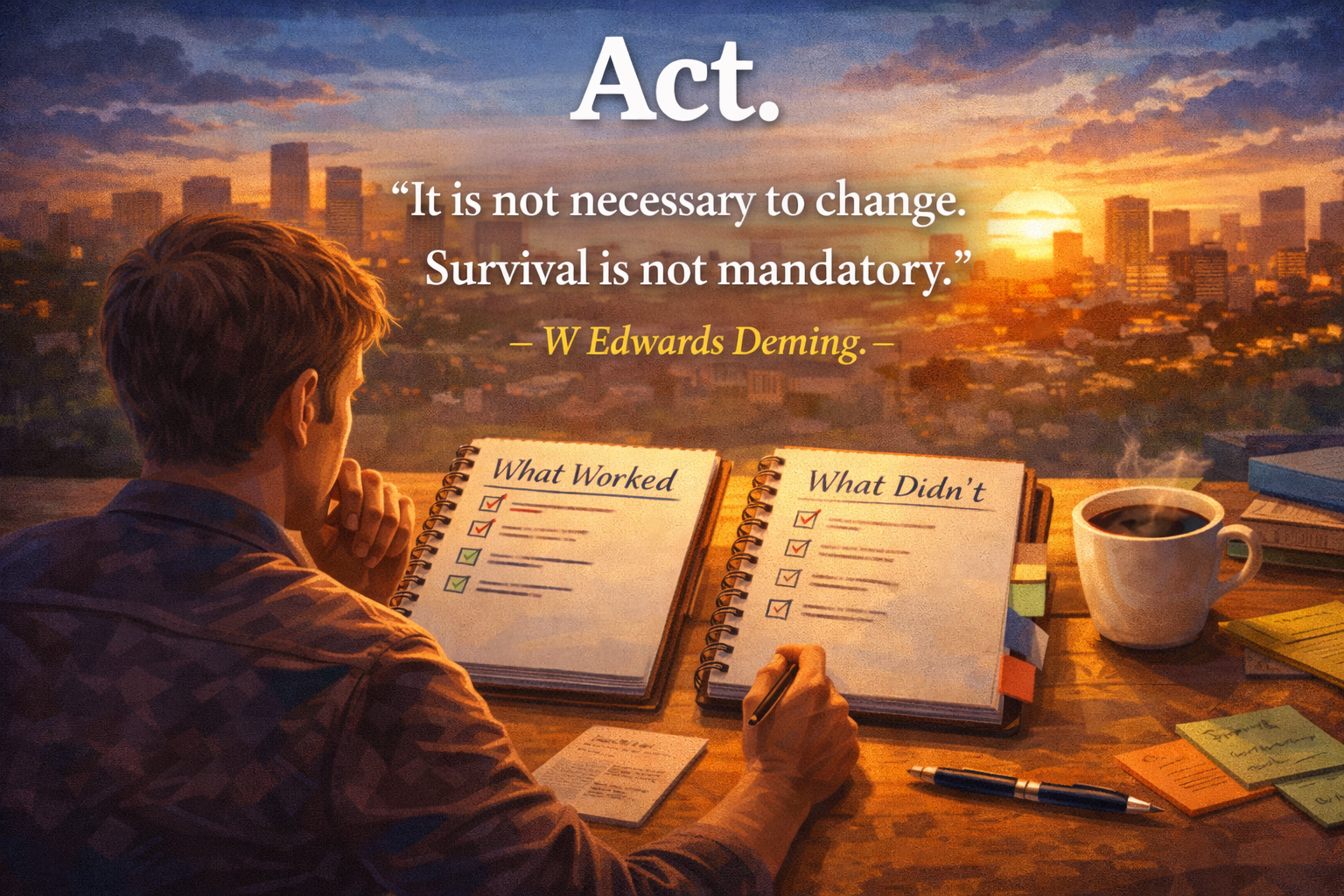
“It is not necessary to change. Survival is not mandatory.” – W Edwards Deming
The fourth step of the Plan, Do, Check, Act cycle is to Act. This refers to acting on the results you identified through the check practice. After reviewing your feelings along with a number of performance indicators, things may not completely align, some will look good, some will not. However, after this review, you should have a good idea of what worked well and what didn’t work well. if you don’t keep at it for a bit longer and reevaluate. From there you have a few options on directions to go.
Stay the Course: If you’re feeling good about your current activities, that’s great, keep up the good work and keep going. This is also where you may make small changes, for me changing from 3 longer strength workouts and 2 longer runs, to 5 short strength workouts followed by 5 short runs. My next phase will be to revisit these to make the strength workouts more cohesive and make sure every run has a better defined purpose that aligns to the strength training (sprints, tempo, recovery, etc).
Double Down: Be honest with yourself, if things seem okay, but the results aren’t there, are you giving it the right level of effort? Personally, I’ve done this a few times with strength training, I would give it a try, then look back and determine I was dawdling with it when I should have been jumping in. This could mean increasing the intensity, duration or both, but you may need to be a bit conservative to avoid overdoing it.
Deload: Sometimes you may feel that things are generally going well, but it’s time for a deload week where you adjust your workout volume (intensity, duration or a combination) for a week. I’ve been here a few times with cycling, I tend to increase my distance each time, but after a rough ride, I may decide I need a light week, generally about 60% duration, before returning to my current level and increasing.
Pivot: Sometimes different activities don’t click with you as well as you hoped. If you were really excited about it, you can stay the course or double down, but removing it and generally replacing it with something else is often a good option. There’s no shame it admitting something didn’t work for you, at least right now. If you’re really attached to the idea of it, keep it on a list to come back to later when you’re feeling more fit. This is where I keep yoga, it seems like a great activity and I’d really like to see the benefits from a flexibility and mindfulness aspect, but based on my last attempt, it’s on hold.
I like having a list of activities I would like to try, these are things you can work in over time, some will be great additions, some will be so/so, some might even be bad, at least in the way you apply them at the time. Some ideas for things I have here include push-ups, pull-ups, BOSU, foam rolling and of course, yoga.
In our culture, January 1st is a great time to start new things and if it works for you, take full advantage of it. However, many people try things each new year then quickly fade back into old routines and wait for another January 1st to try again. It’s important to understand that any day is a good day to start, or start again. For me, I like to have some significance when I draw a line in the sand, New Year’s is one of many of these potential lines. It may also include events, these could be related to fitness (I.e. 5K Run) or just life (I.e. Vacation). After any major event is a great time to start again or start with some adjustments. Likewise I tend to try things for at least a month, so the beginning of a month is a good time to start things. Lastly when I’m in a slump, sometimes the start of a new week (Monday for me) is the lever I need to make a change.
While act is listed at the final step, PDCA is a cyclical process which means once you’ve made some adjustments based on your check data, it’s time to revisit your plan, do your plan, check your results and act on those results again. This cycle repeats over and over, every time it turns over, it brings you to a higher level with improved standards.